
Even though true equality of opportunity may have seemed (and may still seem) like an ideal yet to be fully achieved, both systems have held out this promise to young people…
You suddenly realize that you have to take an exam you had completely forgotten about. You rush to the building, arriving just in time and out of breath. After your registration and ID are checked—and your personal belongings are thoroughly searched to ensure they contain no prohibited items—you finally make your way to your desk.
No sooner have you taken your seat than a proctor walking among the test-takers grades your test, while you listen to the instructions given by an exam supervisor: “Any attempt to cheat will result in immediate disqualification,” he emphasizes. Your exam paper must not bear any identifying marks, must be written in black ink, and must be anonymized at the end of the allotted time, after which it will be graded by two graders.
As soon as you start reading the text, everything changes: it's written in ancient Chinese, but (without knowing how) you manage to read it!
And then you panic—“Confucians?! I don’t know anything about them!”—your heart starts racing, and then, with a sigh of relief, you wake up and realize it was just a dream!
The Ancient Origins of Modern Competitions
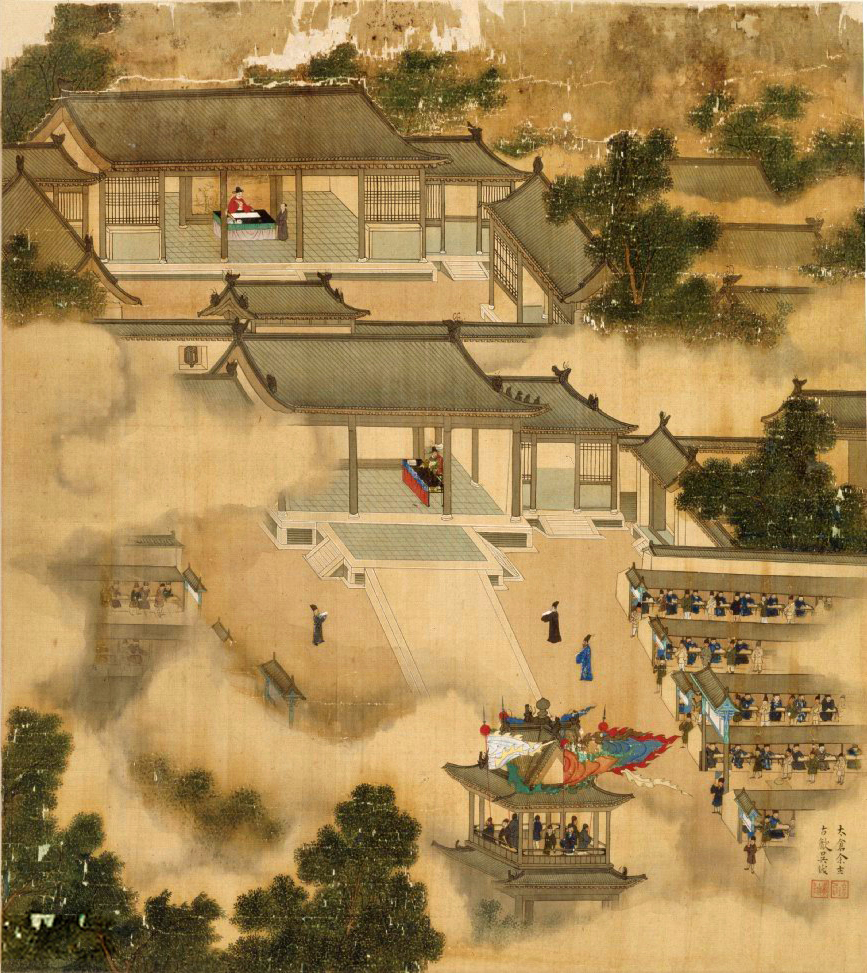
This exam could have been (at least until the topic was revealed) for the French baccalaureate or a French competitive exam, even though the example is taken from a Chinese competitive exam from the mid-16th century! And the process in imperial China would have been almost the same several centuries earlier. Over the course of successive dynasties, in fact, the procedures for recruiting senior imperial officials through examinations in China evolved into a true national assessment institution (known as “ kējŭ ").
Established in the 14th century and maintained until 1904, this system was designed to certify the candidates deemed most deserving by ensuring fairness among them, preventing cheating and corruption, and promoting a certain degree of social mobility (among families wealthy enough to provide an education for their sons)…
However, there are certain similarities between the kējŭ and the French civil service examinations are no coincidence. Indeed, Jesuit writings on this subject (including those by Matteo Ricci, published in 1614) left a lasting impression on the Enlightenment thinkers and their precursors—from Vauban to Voltaire— there is a particular interest in the selection of enlightened administrators through competitive examinations—a practice already in place in China—which ran counter to the purely hereditary system in France under the Ancien Régime.
From the very first admission exams in France—established by Vauban in the 1690s for engineers wishing to work on fortifications—through to the first republican competitive examination in 1794, the explicit goal was to recruit candidates based on knowledge and reasoning skills deemed relevant, just as was the case for the kējŭ.
What was considered relevant? Primarily the classical Confucian texts for Chinese mandarin officials (although there were recurring debates on this point throughout the various dynasties), but mathematics above all for the French. The main focus of the Chinese examinations was to foster a common cultural foundation among the literati, despite the existence of more practical fields of knowledge (such as mathematics and law, for example), which would later be incorporated into the curriculum of the kējŭ in the 14th century. In contrast, entrance exams for the grandes écoles were slow to incorporate requirements aimed at fostering a broader general education (notably with the introduction of the baccalaureate diploma requirement in the 1850s).
The examinations observed by the Jesuits in China were already in written form, whereas oral exams predominated in France until the mid-19th century. The main reason for this shift toward written exams, in both France and China, was the same: the massive increase in the number of candidates. In both cases, this shift was part of a national effort to increase the number of schools and make them more accessible (as early as the 10th century in China).
Old and New Techniques for Equity
In both contexts, assessment procedures have evolved to maximize fairness and minimize the risk of cheating or collusion. However, when an exam is no longer a one-on-one interaction between an examiner and a candidate, issues of fairness, the possibility of cheating, and the reliability of graders take on an entirely new dimension: the more distant the evaluation criteria seem to the candidate, the more likely they are to develop fears of arbitrariness and injustice.
Hence, no doubt, the French legend of the grader throwing a stack of papers down the stairs to determine the grades (each corresponding to a step), with a modern twist: the dart method. In imperial China, we find the same anxieties, which likely turned into resentment in the case of the Chinese writer Pu Songling, who (after failing several civil service exams in the 16th century) wrote short stories on this subject. In the story titled “The Archivist in the Afterlife,” he describes an encounter between two students and a blind sage who claims to be able to determine the true value of an essay by the smell of its ashes… unlike the official graders, who are completely blind—both in sight and in smell!
How, in such a context, could institutions demonstrate the fairness and justice of their system? In addition to the entry controls already discussed above, there is a whole series of similar measures in both contexts:
| Device | Historical Imperial Examinations | Modern French Competitions |
|---|---|---|
| Secure Test Sites | Dedicated, permanent facilities (fortified enclosures with watchtowers, individual cells, pits, etc.) | Fully equipped and designated centers (secure building with enclosed rooms, tables, restrooms, etc.) |
| Candidate Placement Recorded | By annotation on the exam paper (anti-cheating) | By scanning a barcode (sign-in and anti-cheating) |
| Organized Surveillance | By supervised proctors (with a code indicating any irregularities to be reported stamped on the copy) | By supervised supervisors (with a code system for reporting anomalies via incident reports and digital channels) |
| Standardization of Exercises | Through "eight-legged" essays / written with character limits… | Through a three-part essay / summary… |
| Anonymity of Corrections | By physical facsimile (each copy is transcribed by an institutional representative) | By digital facsimile (each copy is scanned by an institutional representative) or by computer transfer |
| Batch Grading of Exams | By sub-examiners and chief examiner(s) | In pairs of graders, with supervision by supervisors |
| Standardization of Corrections | By Marks on the Exam Papers (Reading marks and standardized symbols to be marked on the exam paper) | Using digital methods (grading scales, annotations, statistics, tracking page views, etc.) |
The list above highlights not only numerous parallels between the two systems, but also a few particularly significant differences: the buildings used for the Chinese imperial examinations were veritable fortresses with an almost prison-like atmosphere (as Pu Songling notes in one of his short stories), whereas modern examinations in France take place in rooms equipped not only for security and supervision, but also to meet health and safety standards. In both cases, a significant apparatus is mobilized to ensure a certain conception of fairness and justice.
It should be noted, however, that both systems excluded women until very late in history and remained inaccessible for a long time de facto for many young men. Nevertheless, even though true equality of opportunity may have seemed (and may still seem) like an ideal yet to be fully achieved, both systems have held out this promise to young people and have devoted substantial resources to it, despite the risk of disappointment.
Developments, Frustrations, and Outlook
The systems used by assessment institutions have evolved over time, but cheating methods have adapted as well. Moreover, with the increasing number of students, effective monitoring is becoming more and more difficult.
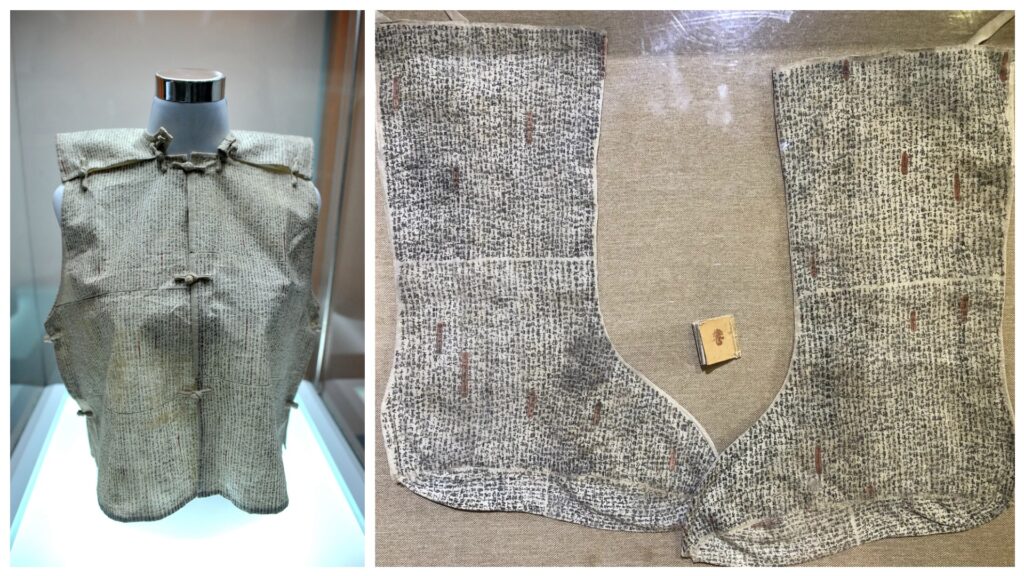
As a result, well-to-do Chinese students who struggled in school managed to obtain such impressive cheat sheets (with “fly-head” writing on fabric or thin clothing) that some are now on display in museums, while the ingenuity of clever French students has been the subject of comic books and comedy films, such as Claude Zidi’s *Les Sous-doués*.
These days, connected devices and AI-powered automatic text-generation systems have become the bane of testing authorities around the world. Starting with cell phones, would-be cheaters may now try their luck with connected watches or glasses to ask a chatbot to prompt them with answers.
And what about grading in such a context? Will the future consist of “exams” evaluated by artificial intelligence, perhaps even with the grading taking place right in front of the test-taker? This possibility, which was virtually unthinkable five or six years ago, is becoming conceivable today. Assuming it were actually possible, would it be in the public interest? Setting aside other considerations, the probabilistic basis of current AI systems might cast doubt on this, especially in light of findings from the field of assessment science… but that will be the subject of a future article.
Some Bibliographic References
BELHOSTE, B., “Anatomy of a Competitive Exam: The Organization of the École Polytechnique Admissions Exam from the Revolution to the Present,” History of Education, No. 94 (2002), 141–175.
CHU, S., “Failure Stories: Interpretations of Rejected Papers in the Late Imperial Civil Service Examinations,” T’oung Pao No. 101 (2015), 168–207.
ELMAN, B. A., Civil Service Examinations and Meritocracy in Late Imperial China (2013).
MERLE, P., “The French School System and the Invention of Grades: A Historical Perspective on Contemporary Debates,” French Journal of Education. Educational Research, No. 193 (2015), 77–88.
MIYAZAKI, I., China’s Exam Hell: The Civil Service Examinations of Imperial China (1976).
O’SULLIVAN, B. and CHENG, L., “Lessons from the Chinese Imperial Examination System,” in Language Testing in Asia, vol. 12, no. 1 (2022), 52–72.
TSIEN, J., “Examination Systems for Civil Service Recruitment in China (from Confucius to the Present),” The Administrative Review, vol. 17, no. 99 (1964), 295–301.
YU, L., “Standards of Validity and Essay Grading in Early Qing Civil Service Examinations,” in Powerful Arguments: Standards of Validity in Late Imperial China (2020), 393–430.