
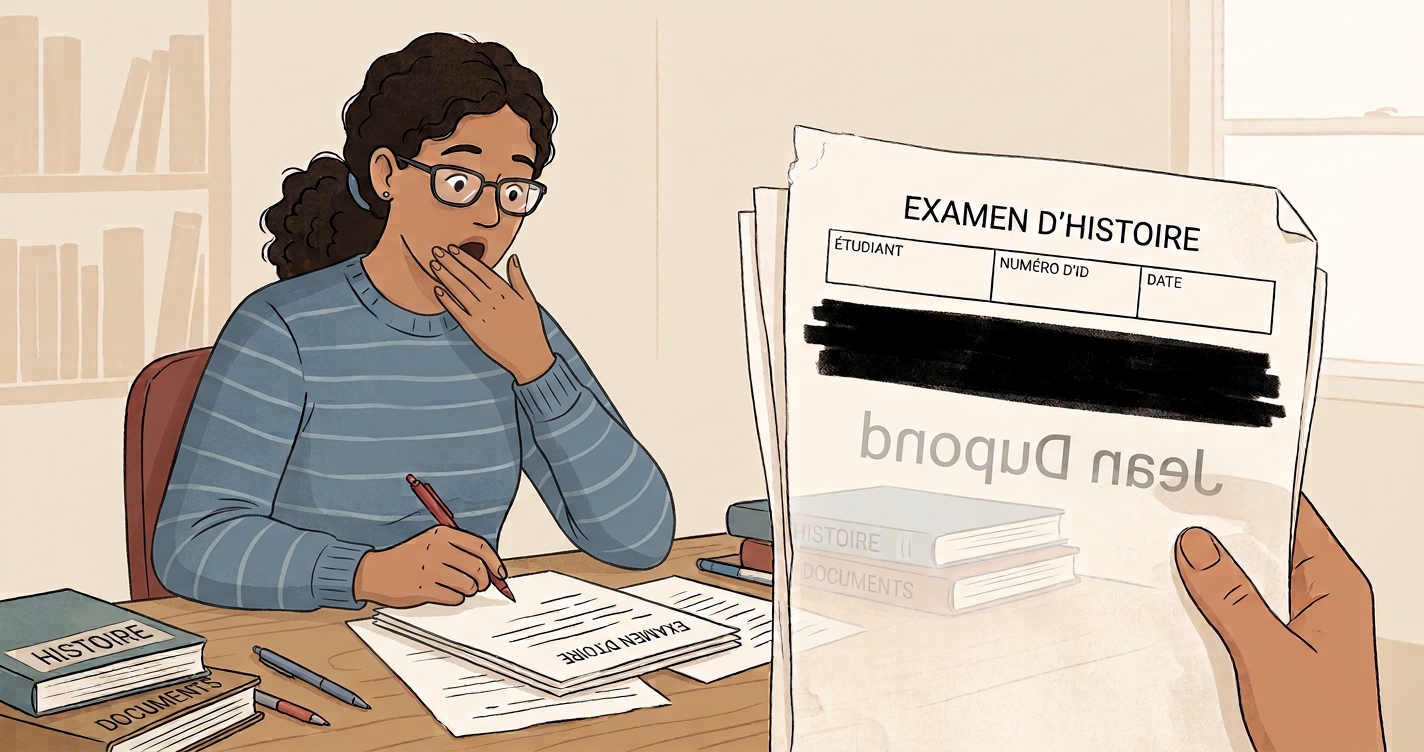
A Contest, thousands of copies, one unbreakable rule: the grader must not know who wrote it.
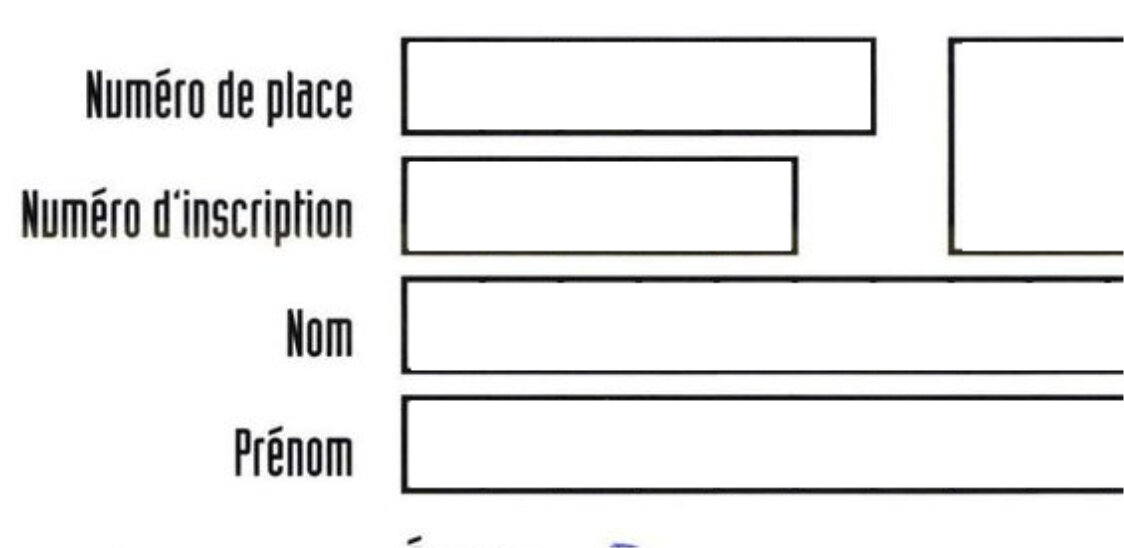
The mechanics are simple. We're scanning the copy. Look for the identification box at the top of the page. Place a mask over it. The name disappears.
The mask is applied. In the right place. On the right side.
And that's exactly the problem: right side up.
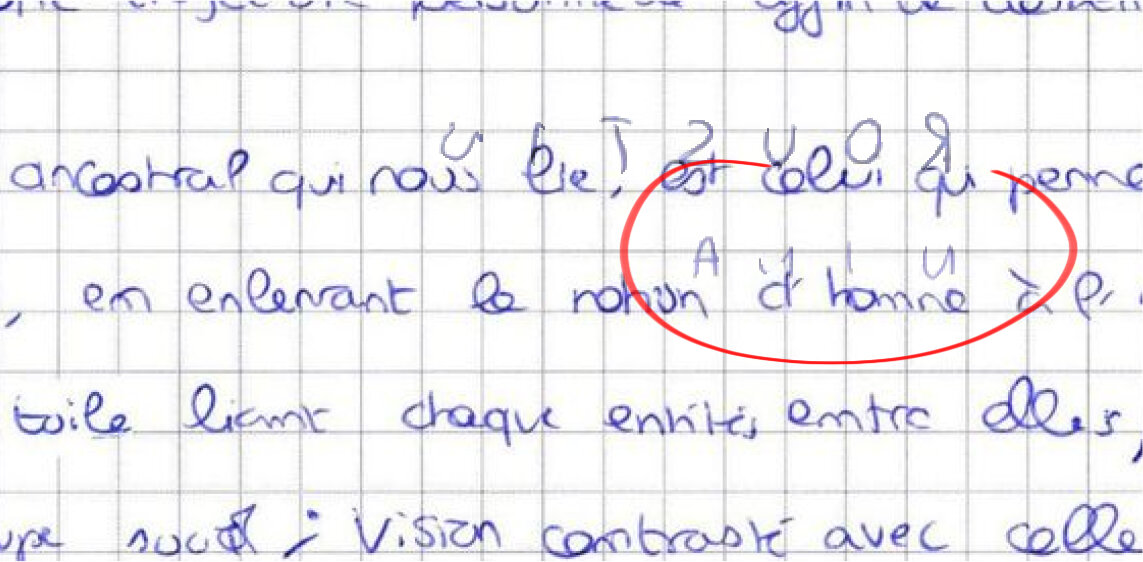
| Front - Masked identification | Back - mirror image |
|---|---|
 |
 |
A sheet of paper has two sides
A test-taker writes with a marker. Or the paper in the test booklet is a little too thin. The ink bleeds through.
Turn the sheet over: you'll find a mirror image of what was written on the other side. Sometimes there are a few stray dots. Sometimes it's a perfectly legible mirror image.
And if what slipped through was the identification label, then the candidate's name appears on the back of the previous page. The proctor didn't notice anything; he was working on the front side.
It's a silent glitch. No alarm, no error message, no log entry. The hidden copy appears flawless—and one page later, the name reappears.
First idea: Let's clean up
That's any engineer's instinct. Identify what's in the way. Remove it. Clean up the image.
That's exactly what we're not allowed to do.
A graded exam is subject to dispute. A student may request to review their exam—and what they should review is her A copy. Not a version enhanced by an algorithm.
The coffee stain must remain. The eraser mark must remain. The illegible crossing-out must remain illegible. If the software has discreetly erased what was problematic, the document’s probative value collapses—and the organizer’s defense along with it.
The objective is therefore not “to make the image legible.” It is:
Remove the transparency. And absolutely nothing else.
That changes everything. The standard measure of success in image processing— Does this read better? - gives way to a much stricter criterion: Are we sure we didn't touch anything else?
In this case, a false positive does not compromise quality. It can, however, affect a part whose integrity is critical.
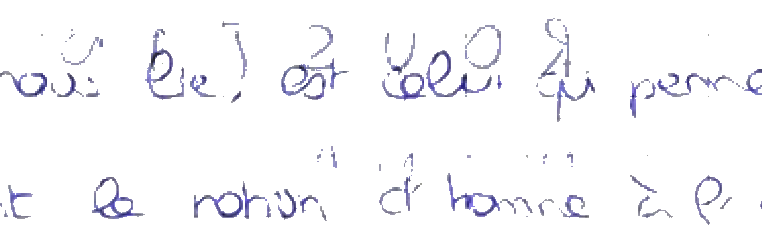
| Reverse side as scanned |
|---|
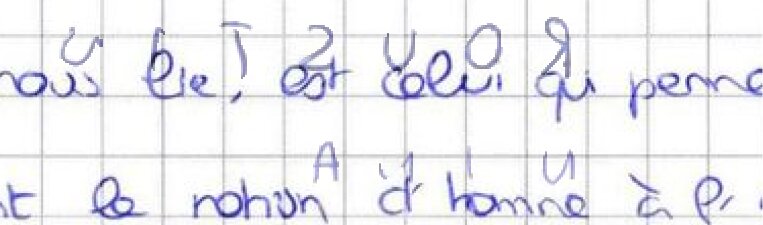 |
| Filtered by threshold : The grid and some of the lines have disappeared, but the darker mirror-image letters remain |
 |
| Hidden Areas : The image is not altered; masks are applied to the mirrored letters |
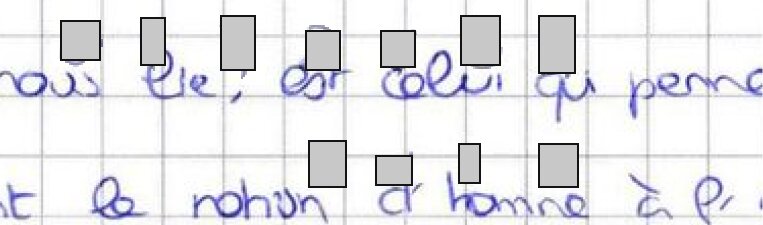 |
Cleaning alters the copy without even removing all of the transparency. Reconstructed illustration.
Second idea: Research has already solved this
Good news: this phenomenon is well-known, has a name, and has been studied. Researchers call it the bleed-through, and have been working on it for several decades—especially on ancient manuscripts, where the ink bleeds through the paper and makes it difficult to read.
Two schools of thought clash there.
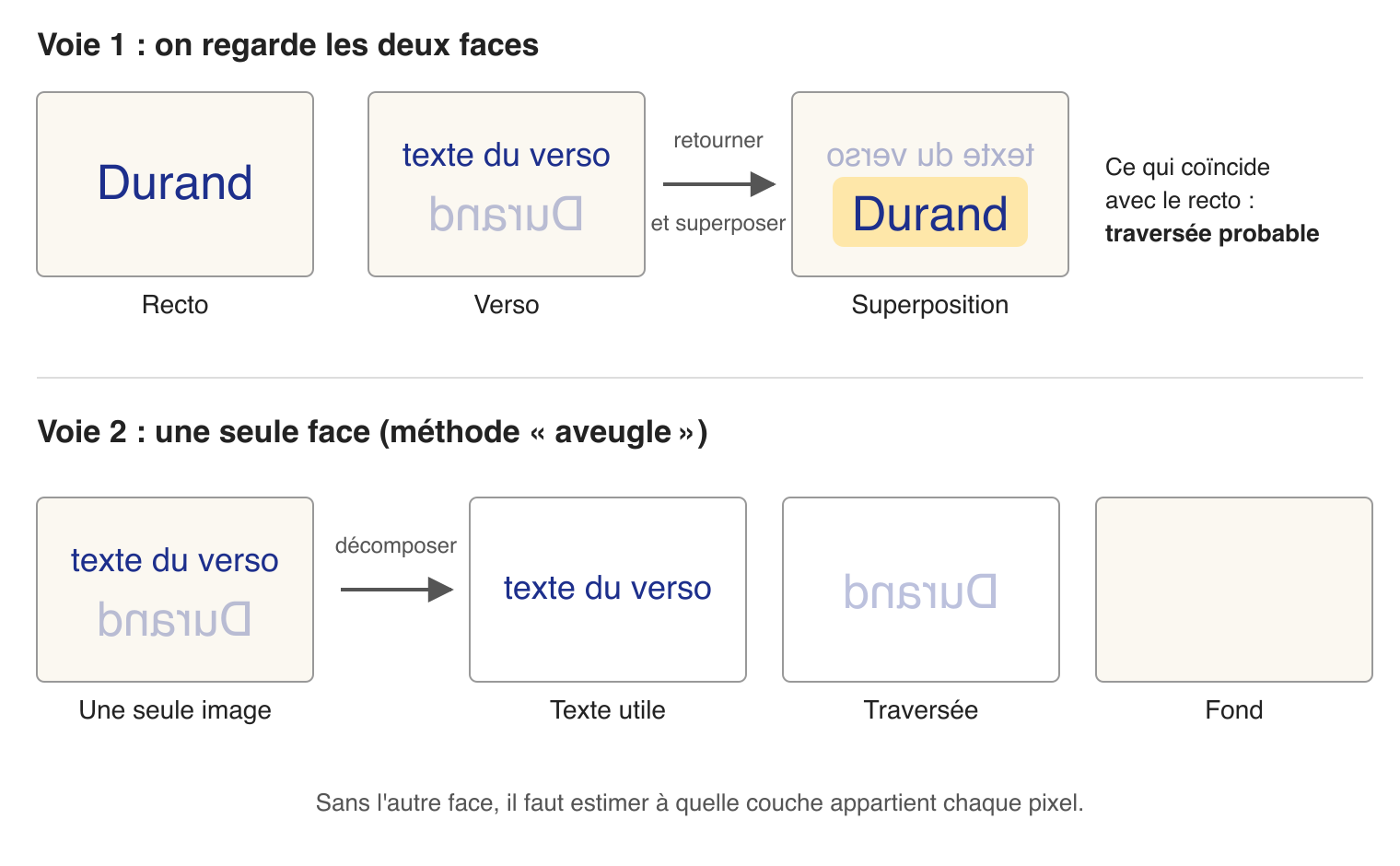
The one who looks at both sides. We scan both sides, overlay them, and whatever appears in the same spot on both sides can help identify the perforation. Three image processing researchers from Trinity College Dublin—Róisín Rowley-Brooke, François Pitié, and Anil Kokaram—published a database of twenty-five hand-annotated page pairs in 2012, and then presented a nonparametric framework in 2013 that makes use of both sides.
The one who only looks at one. Known as blind, it has only one side available and must estimate what belongs to each layer. It breaks down the image into useful text, background, and foreground, relying in particular on pixel neighborhood information. Christian Wolf proposed a random-field method in 2009; Bin Sun and his co-authors revisited this approach in 2016 using conditional random fields.
Other studies address the problem through restoration or binarization: some identify degraded areas and then reconstruct them, while others seek to separate the layers without necessarily reconstructing a faithful color image.
Decades of research, published findings, methods evaluated on corpora. So?
Well, it doesn't work that way here
Three discrepancies, all found in the gap between a historical manuscript and a competition copy.
The right to beautify. With an ancient manuscript, the goal is often to improve legibility; smoothing out the background in the process may be acceptable. With a annotated copy, any alteration to the authentic content poses a problem.
The measurement. The field is capable of evaluating binarization and restoration methods. Since 2009, the DIBCO campaigns (Document Image Binarization Contest), open competitions held in conjunction with major international conferences on document analysis pit research teams against one another and compare their results on annotated corpora, using metrics such as F-measure or distance-weighted distortion. These metrics also penalize the removal of features present in the ground truth.
However, an aggregate score across a corpus does not guarantee the absence of errors in each document. And an F-measure of 0.98 does not, on its own, mean that 2% of the legitimate text was removed: this score combines errors of various types and depends on the class definitions and the evaluation dataset.
These measurements are calculated against a ground truth—a record of what is actually ink. This ground truth exists for annotated test sets, but not for every copy that enters production. Without this independent reference, it is impossible to determine from the score alone whether a particular line was incorrectly removed or correctly retained.
The background. Reconstruction methods must estimate what was beneath the crossed-out text. On an actual copy, the ghost text may overlap an ink stain, a highlight, or a trace of eraser marks. The background to be preserved is therefore not always uniform—and reconstructing it faithfully presents an additional challenge.
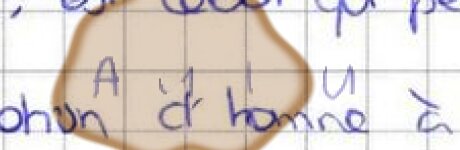
| A stain under the transparent sheet | After cleaning by threshold detection |
|---|---|
 |
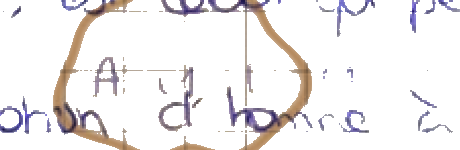 |
Here, reconstructing the background means reconstructing the stain. The thresholding erases the interior of the stain, preserves its outline, and leaves the letters mirrored. Reconstructed illustration.
And the field is still sorting itself out
In addition to the requirement to preserve the original, there are four operational constraints.
Automatic. No manual modifications to individual copies. In our context, a person who opens a copy to remove an identity risks viewing its contents—which compromises the goal of anonymity.
Reversible. The original must remain recoverable in its exact form.
Plotted. We need to be able to say later what was hidden, where, when, and by which version of the treatment.
Fast. The copy is transferred from the scanner to the grader's screen. Processing must be completed within this timeframe.
So, what should we do?
We stop trying to restore the original image.
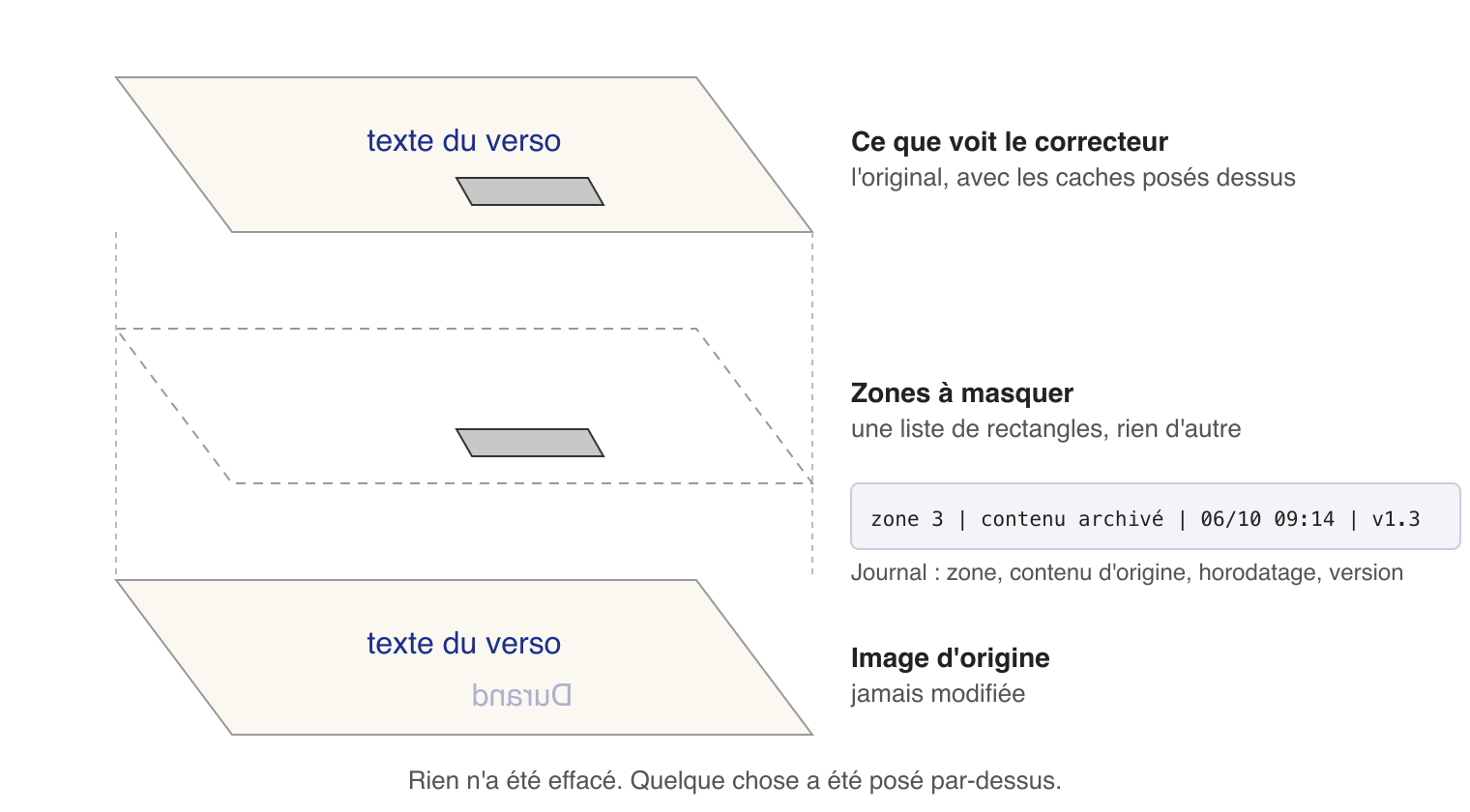
These constraints suggest another solution: not a cleaned-up copy, but a list of areas to hide, applied without altering the source file.
The original image remains unchanged. What the proofreader sees is a layer superimposed on top—one that is reversible, versioned, and has not deleted anything from the file.
In the event of a dispute, it is then possible to keep a record of the redacted areas, their original content, the timestamp, and the version of the processing.
Research on documents is not limited to software-based restoration: depending on the issue at hand, it also involves specialized techniques, such as infrared or multispectral imaging, X-rays, and 3D tomography. These tools are not part of our standard repertoire: here, we have a standard scanner and software. This limitation defines our research question, which is distinct from restoration: identifying and then determining whether a line originates from the other side rather than the side being examined.
That leaves the hard part: doing it automatically, without supervision, and with a sufficient level of confidence, without obscuring any features of the face being examined.
Key Takeaways
An anonymization mechanism can be well-designed, well-coded, and applied in the right place—and still fail, because it considers only one side of an object that has two. No code review can catch that. You have to look at the paper.
And once the flaw has been found, the most obvious technical solution—cleaning up the image—may not be appropriate if the integrity of the copy must be preserved.
This is an issue whenever software processes a document that serves as an official record. The integrity requirement does not come after the solution—it helps determine which solutions are acceptable.